
Author: Hooshyar Khayam
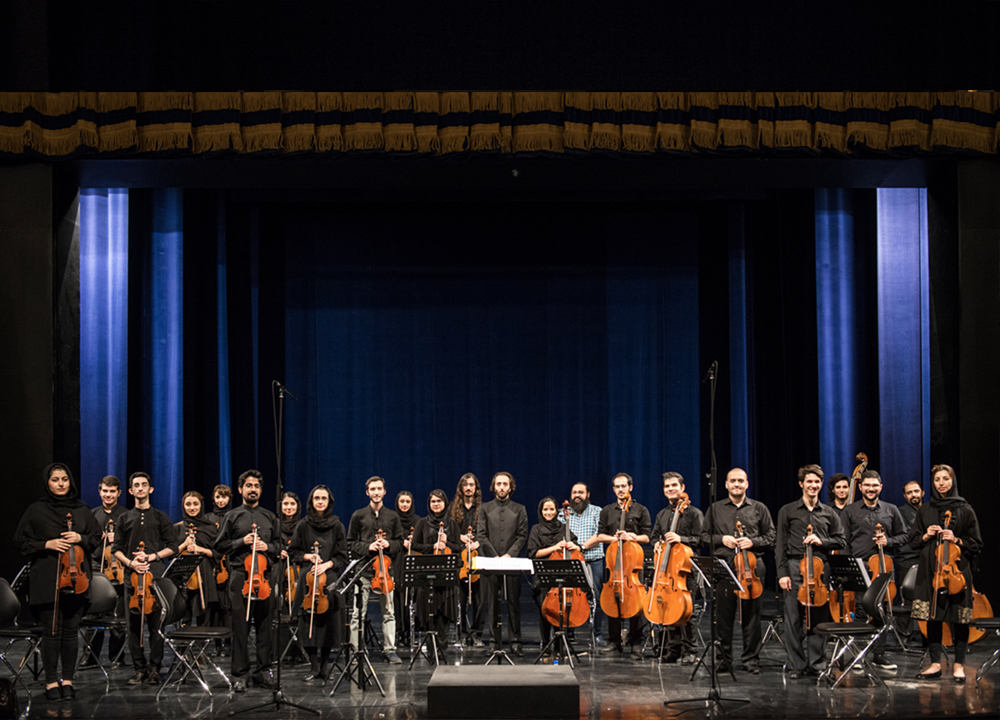
On Tuesday, September 19th, at 9:45 PM, the Nilper String Orchestra took the stage at Vahdat Hall. A concert with a distinct character—performed on the very edge of time.
In its recent formation, the Nilper String Orchestra presented a fresh repertoire with a 6-5-4-3-2 string body, totaling twenty musicians. This year marks Nilper’s thirteenth year of activity. The ensemble has found its own unique voice. In times when its string members are consistently present, Nilper can be compared, more or less, to some of the finest string ensembles worldwide. Shortcomings always exist, but more important is the color of an ensemble—the quality that makes it distinctive and unique.
Nilper’s repertoire is always chosen with intelligence. Though its sonic palette and sound world maintain consistent characteristics, the orchestra’s two recent concerts (the Contemporary Music Festival in May and last night’s performance) revealed different narrative directions in repertoire selection. The prevailing theme of this concert was a journey back in time:
The five selected composers of the program, each in their own way, looked to the past, and this was clearly evident in their pieces. The Estonian composer Tüür generally shapes the form of his works with architectural structures. Hindemith, with the chill and sting of his music, distances himself from the warm lands of the Romantics, defining the neoclassical period in his own unique way. Alireza Mashayekhi dives into experimental music in its fullest dimensions. Gorecki, even to admirers of his Third Symphony, lays bare cold and biting elements from the post-war world. The greatest surprise, however, came in the artistic director’s selection, which revealed unfamiliar facets of these composers. Even Uusberg, with his vivid minimalist colors, briefly but astonishingly opens a path to chorales reminiscent of Mahler and Bruckner in the final bars. Walking the razor’s edge of time does its magic, and a sly late Romanticism finds its way into the music of all five composers. At moments, the music unveils a lost echo from Tristan and its suspended chord, like a rare flower, slowly blooming.
Nilper’s performance may not be flawless, but it is certainly full of surprises. Today, Nilper plays a strong and defined role in engaging its audience with today’s global music. Even the most serious listeners become equally involved and thirst for music throughout the performance. Nilper has its own audience. With each concert, the ensemble’s players grow. Their development deepens the impact of a well-chosen repertoire.
Navid Gohari becomes leaner with every concert, but he holds the spirit of the music. He knows it. He knows the orchestra. He catches the pulse of the music between his long fingers. His performances contain breathtaking moments. The concertmaster, Babak Kohestani, is of rock and eagle: sharp-eyed, and his violin bow spreads wings. The orchestra trusts him.
Ehsan Tarokh served as the concert’s executive director. It was a well-organized event. The program booklet was accurate, informative, and well-crafted. The hall was calm, the musicians relaxed and at ease, both thanks to proper management.
And yet, a puzzling detail: the music community was noticeably absent!
The question remains:
In the span of a whole year, in such a vast country, in a city as immense as ours—how many concerts of this quality and form are held that one can so easily ignore and not attend?
I forget. I close my eyes. The music becomes whole and carries me with it. I drown in a river with cool, refreshing water. I go with the current. I only realize I’ve emerged from the river when I’m far from the concert, walking city streets. After a long time, I lost myself.
After a long time, I find myself again.
Timeless, calm, free—within beautiful music.
Hooshyar Khayam
Composer, Pianist, Conductor, Publisher
September 19, 2017