

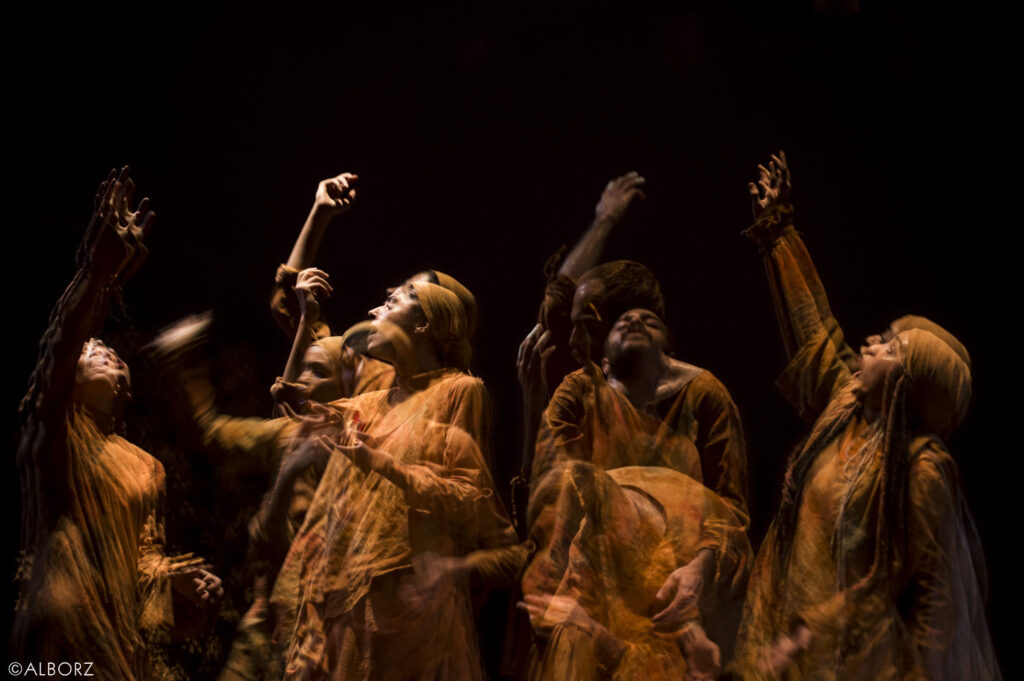
Writer: Neil van der Linden
Promethe/Plague from Iran is a radical adaptation of Aeschylus’ tragedy Prometheus enthralled, which in sound and intensity perhaps comes very close to the original as it could ever have been performed. It was one of the winning productions of the international competition for new opera and music theatre work, Music Theatre NOW. Operadagen Rotterdam was the first to present the production outside Iran.
The decor consists of piles of leaves that are alternately illuminated in red, orange and yellow, representing flaring and smoldering fire. The performers, an actor and three actresses, are constantly on stage from the beginning. All four sing and declaim, the three women also play the musical instruments: a flute, a small harmonium as used in the Sufi music of India, Pakistan and Afghanistan, an accordion and three standing drums. Except for one electronically generated keynote at the end, all the music is acoustic.
Prometheus was the Greek-antique mythological figure, a so-called Titan, who, out of compassion for suffering humanity, stole Olympic fire from the Gods and gave it to the people. He was severely punished for this, and the ‘Nemesis’, the ‘vengeful justice’ was his lot: he was chained to the Caucasus mountain range where the eagle Ethon came every day to eat his liver, which then grew back during the night. Titan’s struggle, the revenge of the gods, fire, mountains, a large bird of prey, all intense elements. These are expressed with shouting, running, emotional gestures, and instrumental sound outbursts. Yet, the result remains measured.
The beautiful music by Navid Gohari offers support. There are bursts of polyphony that seem to have been borrowed from Byzantine and Corsican church chant. The flute evokes associations with the way in which Pan seduced people, just as Prometheus seems to have to be seduced to bring fire, but just as he himself seems to have to seduce people to use fire. The harmonium, not an instrument that you associate with violence, and that is played while sitting, forms a point of rest in the decor and in the music, although the performance ends with a long-held ominous keynote, and the rest turns into fear.
The stage setting, which is indeterminate in time and place, combined with the sometimes raw music, evokes the idea of a time in which primal forces interacted and mythological monster powers fought each other. At the same time, the stage setting could also depict a post-apocalyptic world in which nature still glows after a great fire. Although according to mythology, Prometheus wanted to help man by bringing fire, one can say that this not only ended badly for Prometheus, but also for mankind, who has the difficulty of not doing as much evil as good with that fire.
The performance certainly does not end optimistically in this respect. There are moments of tenderness and mutual affection, but surrounded by the image of the firelight, they do not last long. Intriguingly, Prometheus himself puts a bird mask on one of the other actors. This evokes associations with religious martyrs, not least Jesus Christ, who seek their fatal fate. Christianity and Islam are both cults of martyrdom, and perhaps the makers also want to connect the Prometheus story to the current religion of the Middle East.
The all-encompassing fire in the performance, however, is reminiscent of another religion from the region, Zoroastrianism, the indigenous monotheistic religion of Iran that was founded by the prophet Zarathustra (Greek: Zoroaster) and that still exists, not only in Iran, but also among the Parsi in India, originally from Iran. (NB not only Mr Tata of Tata Steel, and of the Taj Mahal hotel in Mumbai, and of Landrover and Jaguar is an Indian Parsi, but also Freddy Mercury was a Parsi, and the fantastic composer Kaikhosru Shapurji Sorabji.) Did you know that originally, and in well-to-do families in India still, the dead among the Zoroastrians are not buried but are laid out in a kind of stadium in the open air, after which they are supposed to be eaten by birds of prey? If that doesn’t sound like that eagle that comes to eat the liver of Prometheus every night…
Iranian theatre, like Iranian film, has, in addition to realism and absurdism (compare in this respect the Oscar-winning ‘A Separation’ to the oeuvre of filmmaker Abbas Kiarostami), also a movement that builds on the work of the great European theatre innovators of the first half of the twentieth century, such as Antonin Artaud and his Theatre de la Cruauté (the theatre of cruelty), Jerzy Grotowski and Eugenio Barba, the latter of whom created a famous Prometheus production.
Furthermore, the country, which is home to many ethnic groups, has many local traditions, some of which have come from all corners of Asia. The music, costumes, and dance movements are also based on this. Traditionally, there was also close contact with the Balkans and Russia, and with the culture of the gypsies, through the Ottoman Empire and the Caucasus.
The accordion conjures up associations with gypsy and Balkan music, perhaps also Yiddish music. Before mankind, after discovering the use of the singing voice, invented melodic instruments, it already struck objects to make sound, and the three drums correspond to this.
Ultimately, a pandemonium of image and sound ensues, as the earth seems to be on fire. Just as in Northern European mythology it ultimately turns out to be better to return the Ring to the Nibelungs, perhaps humanity should have given fire back to the gods.
Composer: Navid Gohari
Directed by Mehdi Agahikeshe
Performers: Sarah Akbari, Niloofar Nedaei, Tahere Hazaveh, Mohammad Majd Taheri
Visited on May 18, 2019 at the Rotterdamse Schouwburg
Original Article: Prometheus/Plague by Beyn theater